By Angela Queen | May 24, 2026

How the Endocannabinoid System Helps Regulate Stress Response

How the Endocannabinoid System Helps Regulate Stress Response

By Angela Queen | May 24, 2026

Share
Table of Contents
    Add a header to begin generating the table of contents
    By Angela Queen | May 24, 2026

    Stress Is Part of Everyday Life

    But your body was never designed to stay in “go mode” all the time.

    When stress becomes constant, your nervous system can start to feel overloaded—leaving you wired, tired, and struggling to recover.

    That’s where the Endocannabinoid System (ECS) comes in.

    This powerful internal system helps regulate your body’s stress response and plays an important role in maintaining overall balance throughout the body.¹ ²

    Let’s explore how it works: What Is the Endocannabinoid System? A Beginner’s Guide to How CBD Works.

    What Is Stress Response?

    Your stress response is your body’s built-in alarm system.

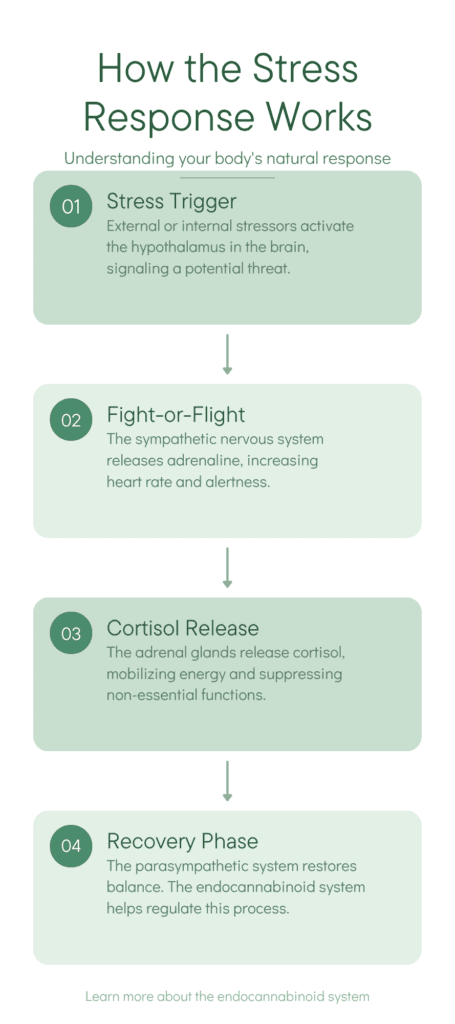
    When your brain detects a threat—whether physical or emotional—it activates your fight-or-flight response.⁴

    This can trigger:

    • Increased heart rate
    • Faster breathing
    • Muscle tension
    • Heightened alertness
    • Release of stress hormones like cortisol⁴

    In short bursts, this response is helpful.

    But when stress becomes chronic, it can start affecting:
    • Sleep
    • Mood
    • Digestion
    • Energy
    • Overall wellness⁴
    Infographic illustrating the body's stress response process, showing how stress triggers activate the fight-or-flight response, lead to cortisol release, and eventually return to balance through recovery mechanisms supported by the endocannabinoid system.

    The Endocannabinoid System’s Role in Stress

    The ECS helps your body maintain balance—especially during stress.¹ ²

    Its job is to help your body:

    • Recognize stress
    • Respond appropriately
    • Return to balance afterward²

    This process is known as homeostasis, or the body’s ability to maintain internal stability despite changing conditions.¹

    Think of it as your body’s internal reset system.

    When stress spikes, the ECS helps signal:

    *”Okay—time to calm things back down.”*²
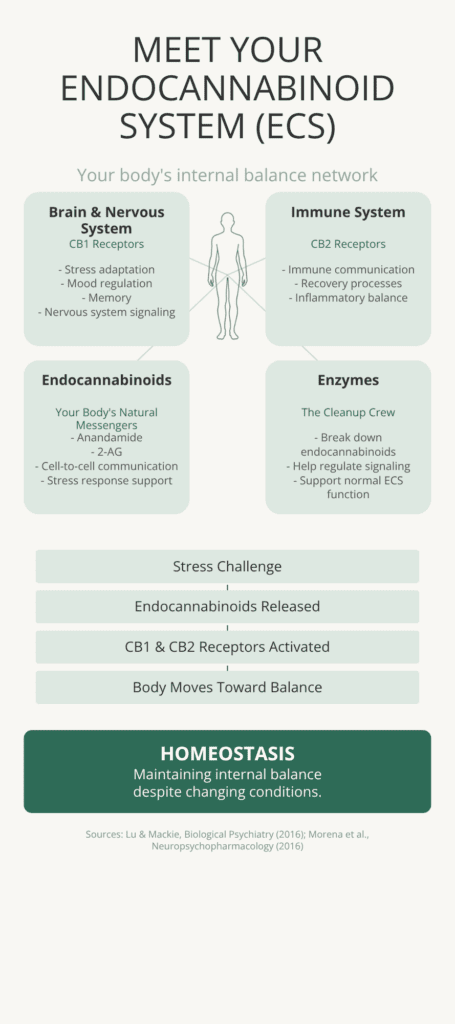
    Educational infographic explaining the endocannabinoid system, including CB1 receptors, CB2 receptors, endocannabinoids, enzymes, and their role in maintaining homeostasis.

    How the ECS Communicates During Stress

    The ECS uses naturally occurring compounds called endocannabinoids

    These act like messengers, helping communicate between:

    • Your brain
    • Nervous system
    • Immune system
    • Body tissues¹

    They interact with cannabinoid receptors throughout the body to help regulate stress-related signals and support adaptation to environmental challenges.¹ ²
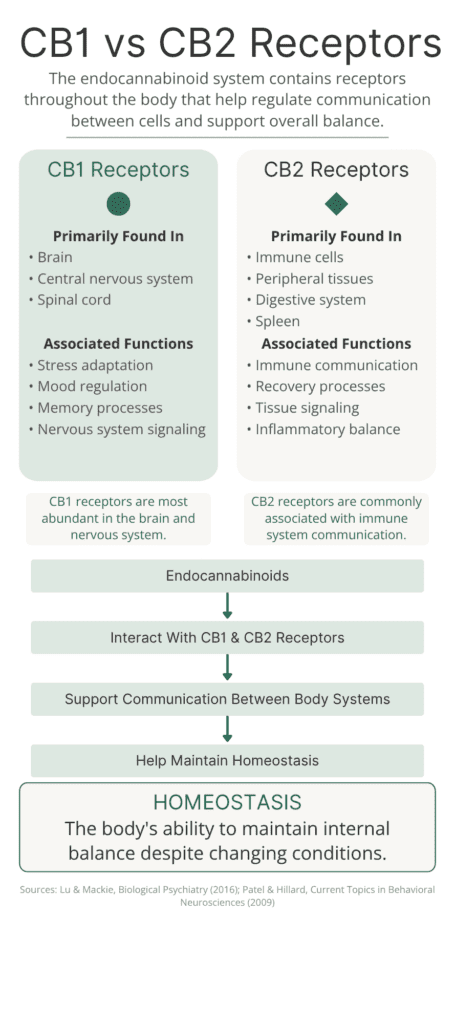
    Comparison infographic showing CB1 and CB2 receptors in the endocannabinoid system, including where they are found in the body and their associated roles in nervous system and immune system communication.

    When functioning well, the ECS may help support:

    • Emotional steadiness
    • Nervous system resilience
    • Better recovery after stressful moments² ³ ⁵

    What Happens When the Stress System Stays Activated?

    Modern life can keep your body stuck in stress mode.

    Common triggers include:

    • Poor sleep
    • Work pressure
    • Overstimulation
    • Constant notifications
    • Emotional overload

    When this happens, many people experience:

    • Trouble relaxing
    • Racing thoughts
    • Irritability
    • Fatigue
    • Feeling “wired but tired”

    Research suggests prolonged stress may disrupt endocannabinoid signaling and make it more difficult for the body to return to balance after stress exposure.² ³

    Over time, your body may struggle to find equilibrium.

    Where CBD Fits In

    Cannabidiol (CBD) may help support the ECS by influencing how the body uses its own endocannabinoids and by interacting with several signaling systems involved in stress and emotional regulation.⁶ ⁸

    This may help support:

    • A calmer stress response
    • Emotional balance
    • A more grounded feeling
    • Nervous system recovery⁶ ⁸

    CBD doesn’t eliminate life’s stressors, but many people use it as part of a wellness routine to help manage everyday stress and support emotional well-being.⁶ ⁷
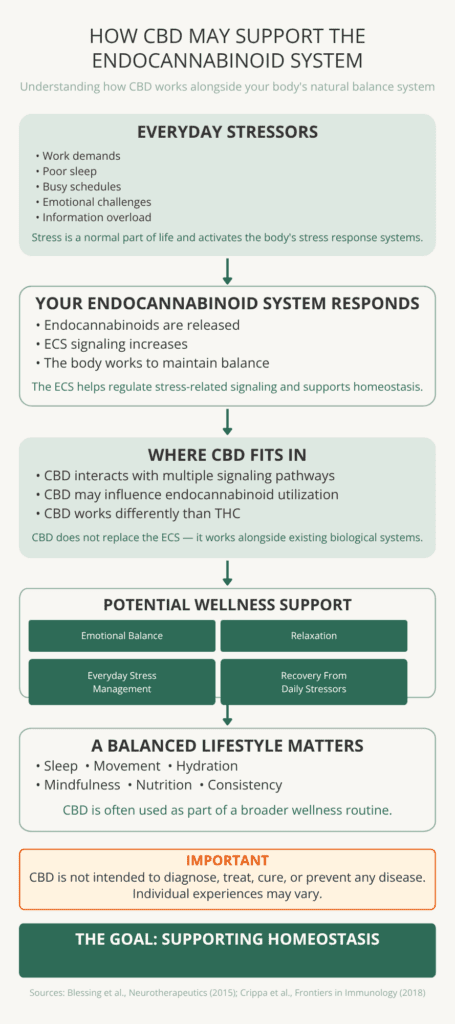
    ducational infographic showing how CBD may support the endocannabinoid system and contribute to everyday stress management as part of a wellness routine.

    Ways People Use CBD for Stress Support

    Everyone’s routine is different, but common approaches include:

    Morning Support

    Start the day feeling balanced and focused.

    Midday Reset

    Use CBD during periods of heightened stress or demanding schedules.

    Evening Unwind

    Support recovery and help transition out of “go mode.”

    Consistency often matters more than timing.

    Supporting Your Stress Response Naturally

    CBD can be helpful—but it works best alongside healthy habits.

    Try combining CBD with:

    • Sleep hygiene
    • Regular movement
    • Breathwork
    • Hydration
    • Time outdoors
    • Mindfulness practices

    The goal isn’t to avoid stress completely.

    It’s to build resilience.² ³

    Choosing the Right CBD for Stress Support

    At RedeemRx, we recommend:

    For Daytime Calm

    • CBD tinctures
    • Low-dose gummies

    For Stronger Evening Relaxation

    • Higher-strength formulas
    • THC-enhanced products where legal

    Explore: CBD for Stress Collection

    Final Thoughts: Your Body Was Built to Return to Balance

    Stress is inevitable.

    Staying stuck in stress doesn’t have to be.

    Your endocannabinoid system was designed to help your body regulate, recover, and return to balance.¹ ²

    Understanding that system helps explain why CBD has become such a popular wellness tool for supporting everyday stress management and emotional well-being.⁶ ⁸


    References

    1. Lu HC, Mackie K. An Introduction to the Endogenous Cannabinoid System. Biol Psychiatry. 2016;79(7):516-525. PMID: 26698193.
    2. Morena M, Patel S, Bains JS, Hill MN. Neurobiological Interactions Between Stress and the Endocannabinoid System. Neuropsychopharmacology. 2016;41(1):80-102. PMID: 25900004.
    3. Hill MN, McLaughlin RJ, Bingham B, et al. Endogenous cannabinoid signaling is essential for stress adaptation. Proc Natl Acad Sci U S A. 2010;107(20):9406-9411. PMID: 20439721.
    4. McEwen BS, Akil H. Revisiting the Stress Concept: Implications for Affective Disorders. J Neurosci. 2020;40(1):12-21. PMID: 31843897.
    5. Patel S, Hillard CJ. Role of endocannabinoid signaling in anxiety and depression. Curr Top Behav Neurosci. 2009;1:347-371. PMID: 21104371.
    6. Blessing EM, Steenkamp MM, Manzanares J, Marmar CR. Cannabidiol as a Potential Treatment for Anxiety Disorders. Neurotherapeutics. 2015;12(4):825-836. PMID: 26341731.
    7. Bergamaschi MM, Queiroz RH, Chagas MHN, et al. Cannabidiol reduces the anxiety induced by simulated public speaking in treatment-naive social phobia patients. Neuropsychopharmacology. 2011;36(6):1219-1226. PMID: 21307846.
    8. Crippa JAS, Guimarães FS, Campos AC, Zuardi AW. Translational Investigation of the Therapeutic Potential of Cannabidiol (CBD): Toward a New Age. Front Immunol. 2018;9:2009. PMID: 30210498.

    Can CBD Help Support Stress & Emotional Wellness?

    Up Next from Redeem

    Redeem Products

    Introducing CBD Gummies for Immunity & Sleep: Order Yours Today.

    Have you heard? Our new line of all-natural CBD Gummies with Zero-THC are here! These gummies contain zero-THC, no corn syrup, no artificial colors or sweeteners, and no gelatin. Using scientific research and pharmaceutical-grade processes, we’ve blended CBD, important immunity boosters and renowned sleep aids with all-natural ingredients, for two yummy flavors that you’ll look forward…
    Read More +